Database Administrator Resume Examples

Crafting a killer resume for a Database Administrator role is like building a stable structure on firm ground. You’ve got to convey the scaffolding of your skills while flaunting the skyline view of your specific experience. This article’s purpose? To guide you through the art of resume persuasion, ensuring employers see you as the superstar of SQL and not just another byte in the data bucket.
Structuring Your Database Administrator Resume
- Contact Information: Name, phone, email, and LinkedIn profile.
- Summary: Brief overview of experience and career goals.
- Work Experience: Relevant jobs and notable achievements.
- Skills: Key technical abilities and proficiencies.
- Education: Degrees and certifications in relevant fields.
When tailoring your resume for a Database Administrator role, highlight your experience with specific database management systems like Oracle or SQL Server, showcasing any performance optimization projects you've led. Emphasize your skills in data security and backup strategies, detailing any successful implementations or disaster recovery scenarios you've managed.
Pro Tip: Crafting a resume with the right skills and keywords can mean the difference between landing an interview or getting lost in the digital shuffle, especially when ATS is in play.
Crafting an Outstanding Database Administrator Resume
Showcase your achievements by spotlighting specific projects where you improved database performance or security, using precise metrics like a "30% reduction in query response time" or "enhanced data protection, cutting breach incidents by 50%." Highlight your role in optimizing resources by detailing how you "decreased storage costs by 25% through effective data archiving strategies," making your contributions tangible and impactful.
- Use a clean, professional font like Arial or Calibri, with a size between 10-12 points for body text, ensuring headers stand out slightly larger and bolder; this maintains clarity while guiding the eyes to key sections.
- Incorporate clear section headings such as “Technical Skills,” “Experience,” and “Certifications” with consistent spacing, allowing for quick skimming, while using bullet points to break down complex information like database technologies or project achievements.
- Emphasize achievements with quantifiable data, such as "Optimized database performance, reducing query time by 30%," to provide concrete evidence of impact, making use of white space to avoid overwhelming the reader with dense text blocks.
Pro Tip: Tailoring your resume for each job can highlight the most relevant skills and experiences, making you stand out to employers.
Entry-Level Database Administrator Resume Sample
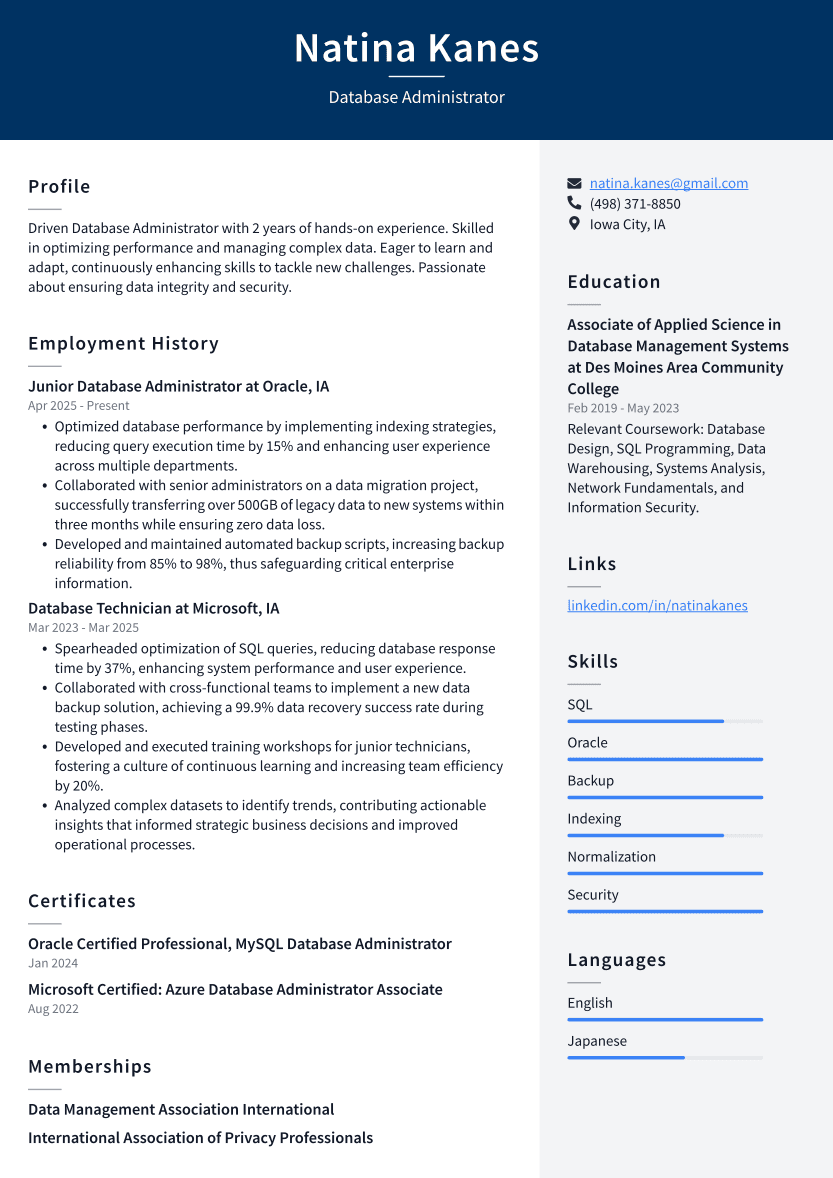
An entry-level Database Administrator resume emphasizes foundational skills and education, while mid-level or senior resumes highlight specialized expertise, leadership roles, and complex project experience.
Resume Example for Experienced Database Administrator
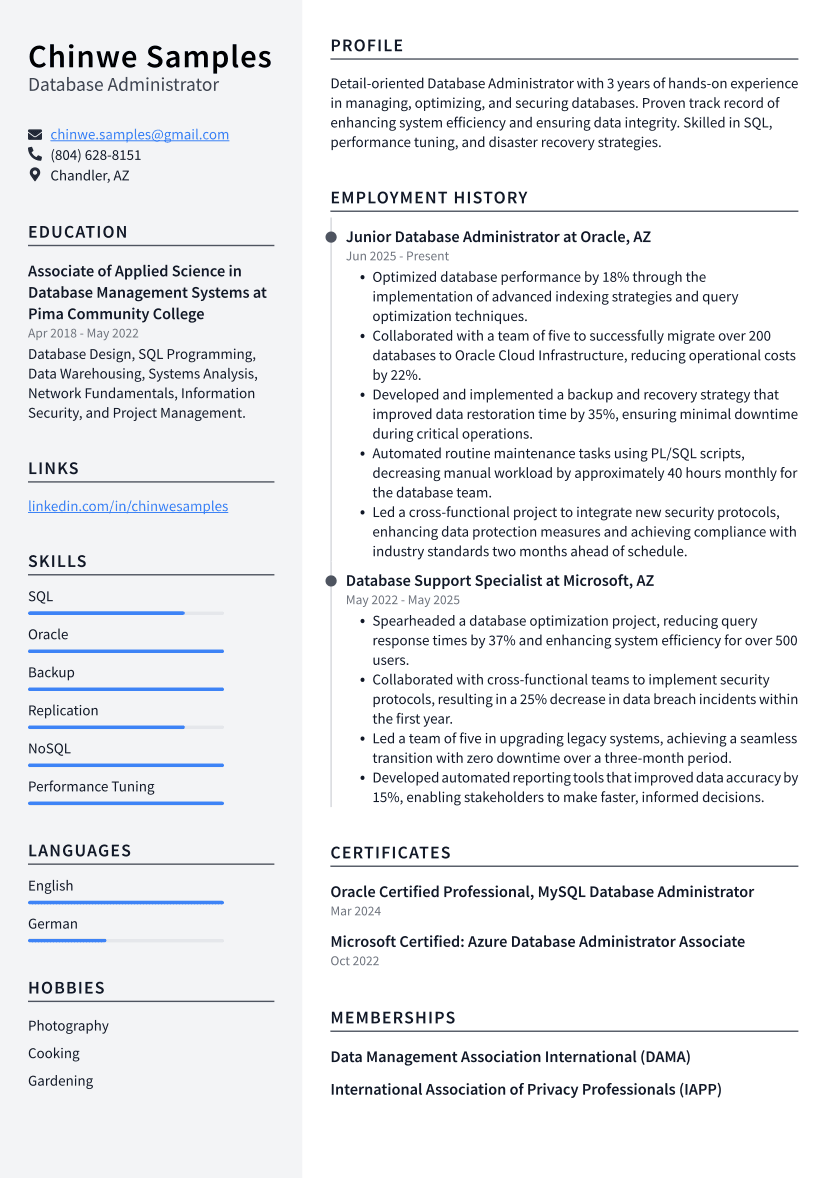
A mid-level Database Administrator resume highlights moderate experience, showcases progressively complex responsibilities, and balances foundational skills with advanced tasks, unlike entry-level's learning emphasis or senior's leadership and strategic focus.
Senior Database Administrator Resume Example
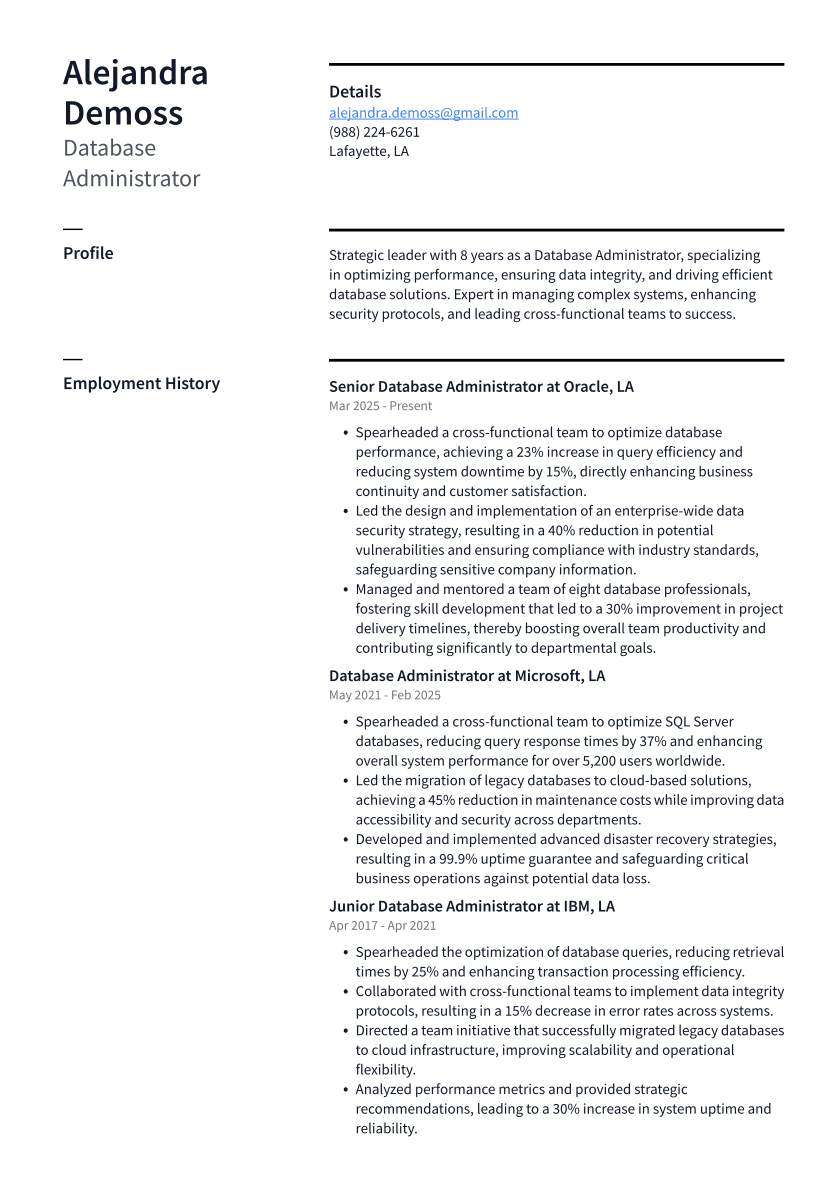
A senior-level Database Administrator resume showcases a wealth of strategic architecture experience, leadership in complex migrations, and mastery over advanced technologies, unlike the entry and mid-level profiles which focus more on foundational skills and hands-on tasks.
Do’s, Don’ts & a Handy Checklist: Database Administrator Resume Guide
DO'S
- Highlight specific skills in database management systems like SQL or Oracle.
- Showcase achievements with quantifiable metrics, such as improved query performance or successful data migration projects.
- Emphasize collaboration and communication skills developed through teamwork on complex database installations or cross-functional projects.
DON'TS
- Don't clutter the resume with every detail; focus on key achievements relevant to the role.
- Don't use vague language like "helped" or "assisted"; be specific about your contributions.
- Don't forget to highlight certifications and technical skills that set you apart.
CHECKLIST
- Highlight relevant certifications to demonstrate your expertise.
- Emphasize your experience with different database technologies.
- Include measurable achievements to showcase your impact.
- Detail a standout project to illustrate your problem-solving skills.
- List technical skills in a clear and organized manner.
- Tailor the resume to match each job’s specific requirements.