Translator Resume Certifications

Certifications on a translator’s resume aren’t just shiny badges—they’re secret passwords to credibility in a world craving proof. This article unpacks why these credentials matter, plus how and where to parade them for maximum impact. Expect some resume magic tricks by the end.
How Certifications Boost Your Translator Resume
A certification beams a translator onto a whole new playing field—suddenly, clients and employers see proof that this isn’t just someone dabbling in languages, but a vetted professional. It stamps your resume with credibility: rigorous testing, specialized knowledge, no guesswork about your skill. In a job market awash with would-be translators, a recognized certificate is like a beacon blinking, “I know my stuff.” When tough choices loom, certified translators tend to rise above the crowd, sparking trust and setting themselves apart.
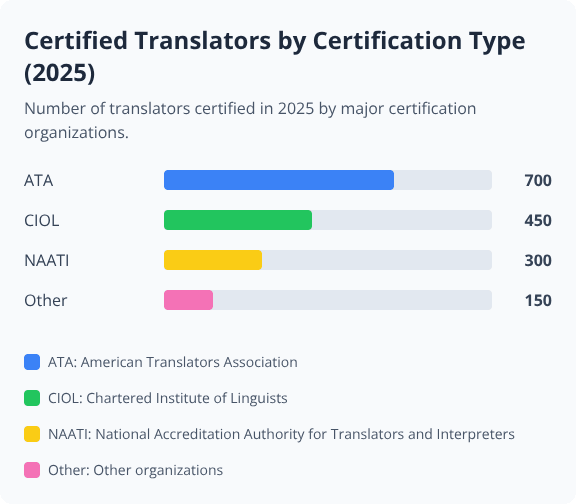
Adding a certifications section to your resume can really boost your chances, especially for translator jobs where proof of language skills matters.
Must-Have Certifications for Translator
American Translators Association (ATA) Certification – Recognized widely in the United States, this credential signals professional-level translation skills and ethical standards across various language pairs.
Chartered Institute of Linguists (CIOL) Diploma in Translation (DipTrans) – A prestigious UK-based qualification, highly regarded internationally, that proves top-level translation competence and subject-matter expertise.
Institute of Translation and Interpreting (ITI) Qualified Membership – Membership with ITI involves a rigorous assessment, confirming both linguistic ability and professional integrity for translators in the UK and abroad.
National Accreditation Authority for Translators and Interpreters (NAATI) Certification – The principal credential for translators working in Australia, ensuring practitioners meet strict standards for quality and ethics.
United Nations Language Competitive Examination (LCE) – Passing this exam opens doors to translation roles within the UN, demonstrating mastery of complex international and diplomatic content.
Canadian Translators, Terminologists and Interpreters Council (CTTIC) Certification – Official Canadian recognition, this certification authenticates a translator’s proficiency in Canada’s bilingual environment.
Cambridge English: Proficiency (CPE) – While not strictly a translation certificate, this high-level language exam is prized as evidence of near-native English proficiency, critical for many translation specializations.
DO'S
- List certifications specific to language proficiency or translation expertise.
- Include the issuing organization and the date awarded.
- Place certifications in a dedicated, clearly labeled section.
DON'TS
- Don’t list certifications that aren’t relevant to translation or language skills.
- Don’t include expired or unverifiable credentials.
- Don’t crowd your resume with outdated certificates from beginner courses.
Pro Tip: Listing the most relevant certifications on your Translator resume instantly signals to employers that you’re not just fluent, but officially recognized and capable—so they waste no time doubting your skills.