Software Developer Resume Certifications

Tossing your certifications onto a resume isn’t just resume decoration—it’s your way of flashing that golden ticket to recruiters skimming stacks of code warriors. This article unpacks why those shiny badges matter and teaches you how to pick and present the ones that actually make tech leads pause mid-scroll. Get ready to turn proof of your prowess into job-offer bait.
How Certifications Boost Your Software Developer Resume
A certification hanging by your name isn’t just an ornament—it signals you’ve put in the time, drilled the hard stuff, and emerged with proof in hand. It’s a shortcut for hiring managers, those busy gatekeepers, to know you’re serious and skilled without sifting through lines of a résumé. Certifications whisper trust, reassure about up-to-date know-how, and often nudge your application just ahead of the next in a crowded stack. In a field where technology never sleeps, that little badge can be the loud clarifier in a sea of technical noise.
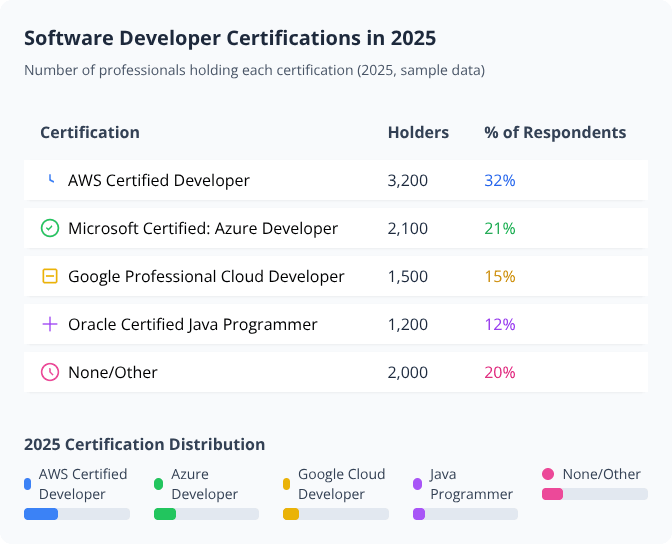
Adding a certifications section to your resume can really boost your chances, especially when software developer roles demand proof of specific skills.
Essential Certifications for Advancing as a Software Developer
Certified Kubernetes Administrator (CKA): Mastering this demonstrates deep skills in container orchestration, which is prized for building and running scalable applications in the cloud.
Amazon Web Services (AWS) Certified Developer – Associate: Recognition here signals you understand core AWS services, architecture, and best practices for deploying cloud-based applications.
Microsoft Certified: Azure Developer Associate: Earning this proves your ability to design, build, test, and maintain cloud applications on Microsoft’s powerhouse Azure platform.
Google Professional Cloud Developer: Presence of this badge points to advanced capability in designing, building, and deploying secure and scalable apps on Google Cloud.
Oracle Certified Professional, Java SE Programmer: Having this proves your mettle in one of the world’s most-used programming languages, opening doors to major enterprise opportunities.
Certified ScrumMaster (CSM): Agile fluency and strong teamwork—this certification showcases your command of Scrum practices, a must-have for thriving in most software teams today.
Professional Software Developer Certification (PSD) – IEEE Computer Society: Validates both practical programming chops and that elusive professionalism, serving as a mark of all-around engineering credibility.
DO'S
- Highlight relevant certifications prominently near the top of your resume.
- Include the official title, issuing organization, and date earned for each certification.
- Tailor certifications to match the specific skills or technologies asked for in the job description.
DON'TS
- Don't list outdated or irrelevant certifications.
- Don't overcrowd your resume with every course you've ever taken.
- Don't forget to mention the issuing organization and date.
Pro Tip: Stacking your resume with the right certifications flings open doors—recruiters barely blink before glancing at what tells them you actually know your stuff; only the most relevant credentials should elbow their way to the top, or they’ll just blend into the static.