Research Scientist Resume Certifications
Slapping the right certifications onto your Research Scientist resume isn't just résumé sprinkles—it’s the secret ingredient that makes hiring managers sit up straighter. This article spills exactly which badges put your expertise in the spotlight and teaches you how to flaunt them like a pro. Ready to turn your resume into a research recruiter magnet? Let’s get started.
How Certifications Boost Your Research Scientist Resume
Certifications act as brightly waving banners—signals to peers and employers alike that a research scientist knows their stuff, not just in theory but by standards recognized beyond any one lab. When complex methodologies or technologies keep evolving, a certification tells the world you’re not stuck in the past. That shiny badge might tip the scales in the job market, too, nudging your application from a maybe to a must-see. In a field jam-packed with smart minds, official proof of expertise can separate a name from the crowd.
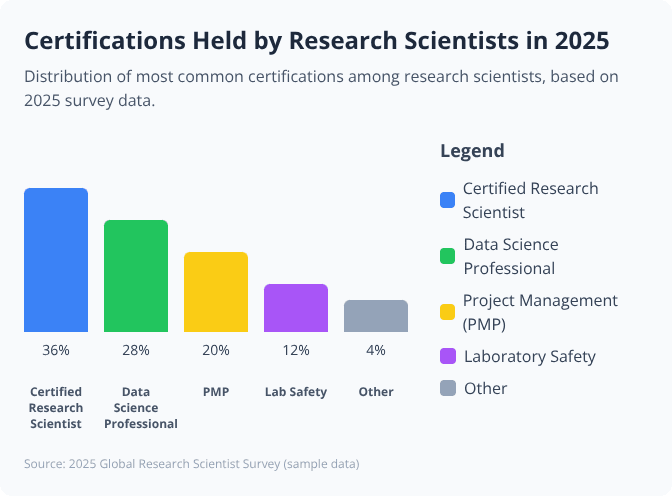
Adding a certifications section to your resume can really boost your chances, especially for research scientist roles that demand proven expertise.
Best Certifications to Add to Your Research Scientist Resume
Project Management Professional (PMP) – Recognized worldwide, this certification showcases expertise in leading and directing research projects with efficiency and global standards.
Certified Research Scientist (CRS) – Signals deep knowledge in experimental design, data analysis, and ethical research practices, boosting credibility in academic and industry settings.
Certified Clinical Research Professional (CCRP) – Validates your command over clinical trials and regulatory compliance, especially valuable in biomedical or pharmaceutical research.
Six Sigma Green Belt Certification – Demonstrates competence in process improvement and statistical analysis—a bonus for scientists optimizing experiments and workflows.
Human Subjects Protection (HSP) Certification – Essential for those handling human data, showing an understanding of ethics, consent, and participant safety in research.
Chartered Scientist (CSci) – Granted by professional bodies, this signals a proven track record in scientific methodology, problem-solving, and leadership.
Certified Data Scientist (CDS) – Highlights mastery in leveraging big data and machine learning for research decision-making, vital as data grows ever more central to science.
DO'S
- Include only relevant certifications directly related to your field or expertise.
- Mention the full certification name and the awarding institution.
- List the completion or expiration date, especially for time-sensitive credentials.
DON'TS
- Don't list outdated or irrelevant certifications that have no bearing on your research field.
- Don't clutter your resume with certifications from unrecognized or questionable institutions.
- Don't exaggerate your expertise by including beginner-level or introductory online course certificates.
Pro Tip: Stacking your resume with only the most relevant certifications slices through the noise, instantly signaling to hiring managers that you’re not just qualified—you’re precisely what they’re after.