Registered Nurse Resume Certifications

Want to make your nurse resume irresistible to hiring managers? Relevant certifications do the heavy lifting—proving you’re more than just scrubs and a stethoscope. In this article, you’ll discover exactly which badges are worth flaunting and how to showcase them for maximum impact.
How Certifications Boost Your Registered Nurse Resume
Nursing certifications act like badges of honor, flashing proof that someone’s gone beyond the basics and dug deep into specialized knowledge. They open the door for trust from patients and colleagues alike—nobody can argue with tangible expertise. When résumés pile up, those few extra letters after a name can catch an employer’s eye and nudge a candidate ahead. Beyond that, certification whispers of ongoing commitment, a promise never to coast but to keep learning in a field that never stands still.
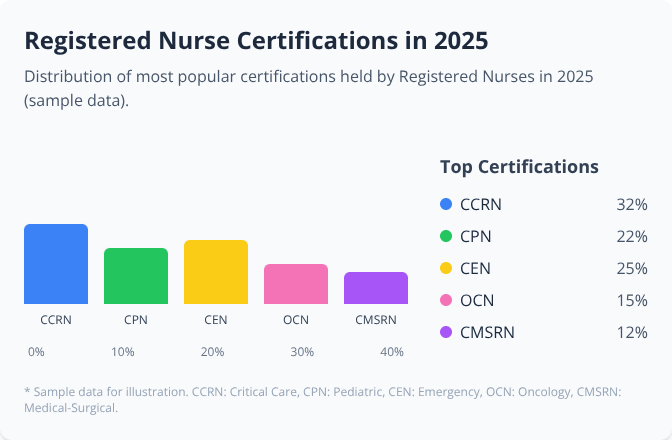
Adding a certifications section to your resume can really boost your chances, especially for nursing jobs that demand specific skills or licenses.
Essential Certifications for Advancing as a Registered Nurse
Certified Critical Care Registered Nurse (CCRN) – Validates expertise in caring for acutely and critically ill patients, opening doors to specialized ICU roles and higher pay.
Certified Emergency Nurse (CEN) – Demonstrates mastery in emergency medicine, boosting credibility and confidence in fast-paced ER environments.
Certified Pediatric Nurse (CPN) – Showcases advanced knowledge in pediatric care, making nurses stand out for children’s hospitals or pediatric units.
Certified Nurse Operating Room (CNOR) – Recognizes skill and proficiency in perioperative nursing, highly regarded in surgical and OR settings.
Certified Oncology Certified Nurse (OCN) – Highlights deep understanding of cancer care, crucial for professionals in oncology treatment and support.
Certified Medical-Surgical Registered Nurse (CMSRN) – Signals excellence in managing adult patient populations, often preferred by med-surg units and general hospitals.
Certified Nurse Educator (CNE) – Distinguishes those with the background to teach and mentor other nurses, essential for academic and leadership roles.
DO'S
- List certifications after your name and credentials at the top of your resume.
- Include full certification titles, not just abbreviations, along with expiration dates.
- Prioritize the most relevant and recent certifications for the job you want.
DON'TS
- Don't list expired or irrelevant certifications.
- Don't use acronyms without spelling them out first.
- Don't forget to include the date earned and issuing organization.
Pro Tip: Because a recruiter’s eyes dart first to proof you can actually do the job, highlighting your most relevant certifications means you’re practically waving a bright green flag that says, “Right fit, right here.”