Physical Therapist Resume Certifications
Missing out on flashing your physical therapy certifications on a resume? That’s like showing up to a marathon without your shoes—plenty of effort, but you won’t get far. This article spills the secrets on why those credentials matter and how to parade them so employers can’t help but notice.
How Certifications Boost Your Physical Therapist Resume
Certifications glint like badges of proof—evidence that a physical therapist isn’t just talking the talk, but knows the science behind every stretch and joint movement. They flag genuine expertise, reassuring patients and employers that the therapist brings focused skills to the table. When job applications pile up, a certification can wink and nudge a candidate to the top, signaling commitment to growth and sharper knowledge. It’s not just a piece of paper; it’s a clear sign you’ve put in the work to stand out in a crowded field.
Adding a certifications section to your resume can really boost your chances, especially for physical therapy jobs that demand specific skills or licenses.
Must-Have Certifications for Physical Therapist
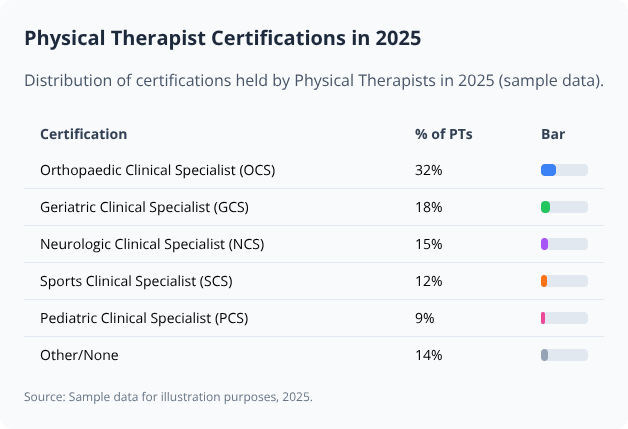
- Board-Certified Clinical Specialist in Orthopaedic Physical Therapy (OCS) – Recognition of advanced clinical knowledge and skills in orthopaedic physical therapy, signaling expertise in musculoskeletal conditions.
- Board-Certified Clinical Specialist in Sports Physical Therapy (SCS) – Validates proficiency in the care and rehabilitation of athletes and those engaged in physical activity.
- Board-Certified Clinical Specialist in Neurologic Physical Therapy (NCS) – Demonstrates specialized abilities in treating individuals with neurological disorders and injuries.
- Board-Certified Clinical Specialist in Geriatric Physical Therapy (GCS) – Highlights advanced competence in the rehabilitation and well-being of older adults.
- Certified Strength and Conditioning Specialist (CSCS) – Focuses on the design and implementation of strength training and conditioning programs, valuable for therapists working with athletic or active populations.
- Certified Lymphedema Therapist (CLT) – Equips therapists with advanced knowledge to manage lymphatic disorders, a key skill for oncology and post-surgical patients.
- Board-Certified Clinical Specialist in Pediatric Physical Therapy (PCS) – Affirms specialized expertise in caring for infants, children, and adolescents with physical impairments or developmental delays.
DO'S
- Do list certifications front and center, right under your name or headline.
- Do include full credential names and relevant abbreviations.
- Do add expiration dates or renewal info if the certifications require them.
DON'TS
- Don't list expired or irrelevant certifications.
- Don't use unofficial abbreviations or acronyms unfamiliar to employers.
- Don't bury your certifications in unrelated resume sections.
Pro Tip: Because drowning your resume in every certification you’ve earned just dilutes the impact—spotlighting only the ones that truly matter shows you know what matters most to employers, and makes you unforgettable instead of just another name on the pile.