Financial Advisor Resume Certifications

A Financial Advisor without certifications is like a magician without a hat—where’s the credibility? This article spills the secrets on why those shiny credentials matter and how to make them dazzle on your resume. Get ready to learn exactly which certifications to flaunt and how to spotlight your expertise where it counts.
The Value of Certifications in Financial Advisor
Clients want reassurance their advisor knows the ropes—certifications broadcast that confidence in flashing neon. A framed credential isn’t just wall decoration; it’s proof of slogging through hours of study, real-world training, and tough exams. Employers see those letters after your name and know you’re serious, not just dabbling. In a sea of applicants, holding a prestigious designation can be the difference between blending in and being plucked from the pile.
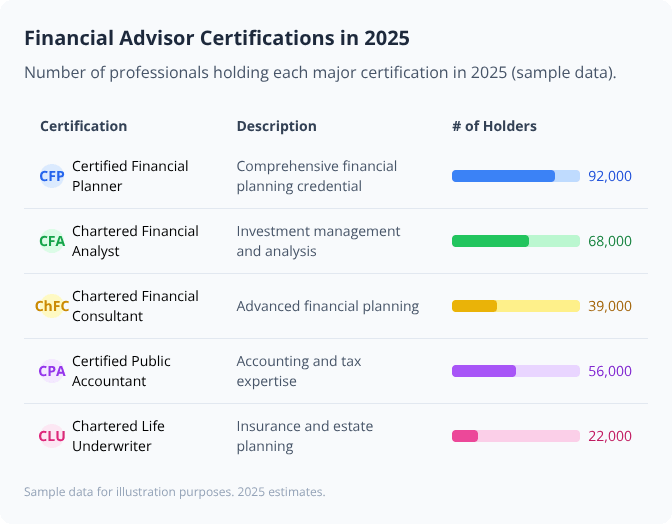
Add a certifications section to your resume—it grabs attention fast, especially for financial advisor roles where proof of expertise matters.
Essential Certifications for Advancing as a Financial Advisor
Certified Financial Planner (CFP): Recognized as the gold standard for financial planners, this certification signals mastery across a wide range of personal finance topics and promotes ethical, client-focused guidance.
Chartered Financial Analyst (CFA): This credential, respected globally, demonstrates deep expertise in investment management, portfolio analysis, and ethical standards, opening doors in wealth management and high-level advisory roles.
Certified Public Accountant – Personal Financial Specialist (CPA/PFS): CPAs who earn this add-on show advanced competence in both tax and comprehensive financial planning, blending accounting acumen with broader advisory skills.
Chartered Financial Consultant (ChFC): With a curriculum similar to the CFP but with additional specialty subjects, the ChFC spotlights advanced planning strategies for clients with complex needs.
Certified Investment Management Analyst (CIMA): Focusing squarely on asset allocation, portfolio construction, and advanced investment consulting, the CIMA shines for advisors serving high-net-worth or institutional clients.
Retirement Income Certified Professional (RICP): Specializing in retirement distribution planning, this certification answers the call from aging clients and organizations obsessed with longevity risk and sustainable income.
Certified Fund Specialist (CFS): Geared for those who frequently recommend mutual funds, the CFS deepens knowledge on evaluating, selecting, and monitoring fund investments in client portfolios.
DO'S
- Do highlight relevant certifications near the top of your resume for visibility.
- Do include the full certification name and the issuing organization.
- Do mention the date earned and note if it’s active or expired.
DON'TS
- Don't list expired or irrelevant certifications.
- Don't use acronyms without explaining what they mean.
- Don't exaggerate or claim credentials you haven't earned.
Pro Tip: Imagine a hiring manager sifting through a mountain of applicants—your resume, bursting with spot-on certifications like CFP or CFA, instantly flashes credibility and says, “Hey, I know my stuff,” before you even step in the room.